From Dark to Live in 72 Hours: Rescuing a Century-Old Gallery's Website
By Spencer Taylor ·
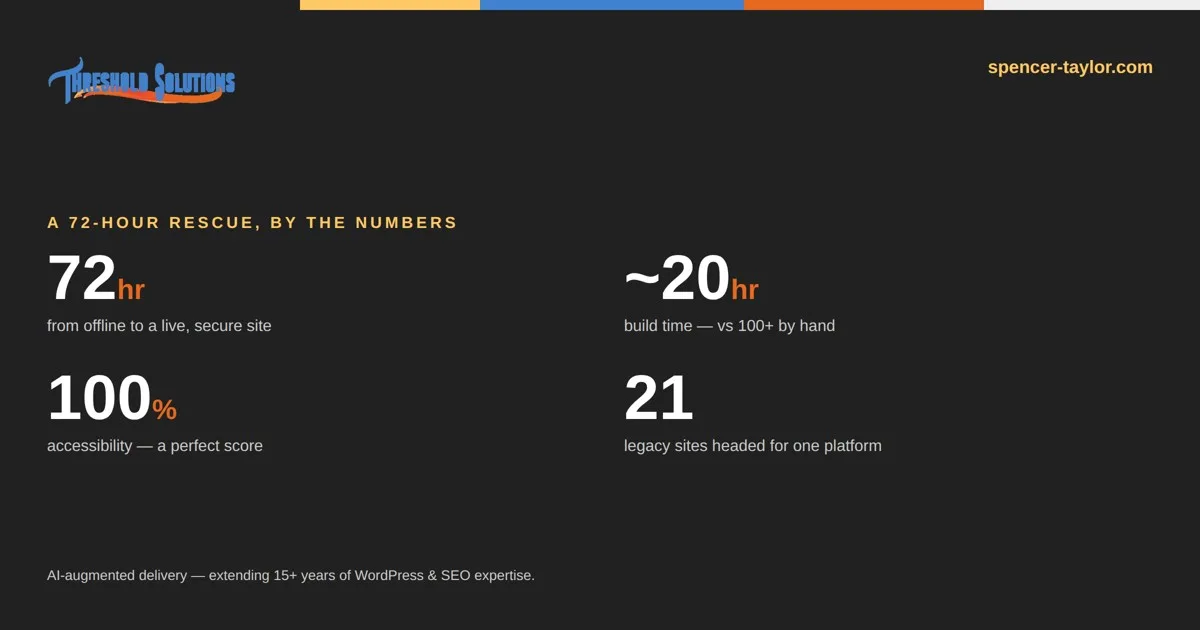
Last week, a respected Philadelphia gallery — more than a century old — woke up with no website. Seventy-two hours later it was live again on a brand-new, secure, extensible site, built from the ground up. Here’s how modern, AI-augmented consulting made that possible — and what it means for your business.
The situation
A century-old institution, suddenly offline
The Print Center is a non-profit gallery I’ve worked with for over five years — a small, passionate team caring for more than a hundred years of exhibition history. Their site had been compromised, and their host did the responsible thing and took it offline to contain the problem. But the result was stark: overnight, a respected century-old organization had no web presence at all — and no technically feasible way to bring the old site back.
Why not just restore it
Why the old site couldn’t just be “restored”
The Print Center’s web presence hadn’t been built once. It had accumulated over more than 20 years into 21 separate legacy websites — one per exhibition and program — some of them older than WordPress itself. Bringing that back would have meant restoring a compromised, sprawling system, on infrastructure that was rightly locked down, with intrusions already installed across several of the sites. The safe, fast path forward wasn’t to repair the past. It was to build clean.
The delivery
A new site, live in under 72 hours
On separate, secure infrastructure of my own, I rebuilt their primary site from the ground up — modern, secure, accessible, and extensible — and had them back online in about three days. Not a patch. A complete, working replacement of something that had taken two decades to grow: every core page and program rebuilt, content reconciled with zero broken links, analytics running, search engines already indexing it, and every function working. On a timeline and budget a small nonprofit could actually afford.
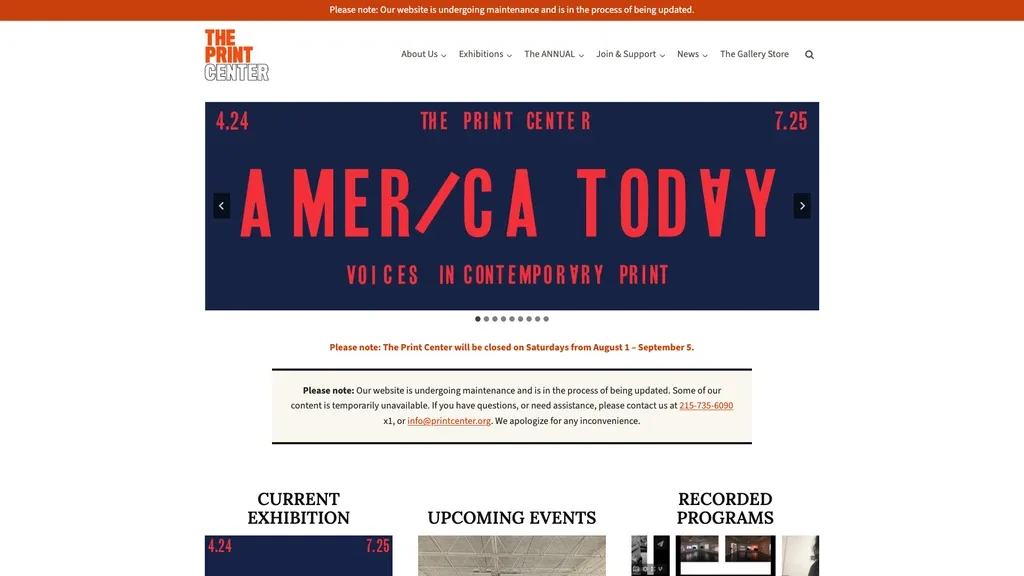
The rebuilt Print Center homepage, live at printcenter.org.
A project like this — sprawling, 20+ years deep, with data scattered across multiple servers and much of it hard to even reach — is normally a multi-week, five-figure agency engagement. Done by hand, this one was easily 100+ hours of work, and at that scale, across that much messy data, it would have been riddled with mistakes.
The headline
It took roughly 20 hours.
That’s not a shortcut, and it isn’t “AI building a website.” Over the past year I’ve put hundreds of hours into researching, building, and training my own modern, AI-powered platform — a direct extension of my 15+ years in web design, development, and WordPress. It doesn’t replace my expertise; it magnifies it. A large, complex, messy problem can now be broken down and executed systematically in a way that simply wasn’t possible before — while I stay on the judgment, the design, the security analysis, and the verification at every step. The expertise is still mine. The tools just let me deliver it several times faster, with fewer errors, than was possible even a year ago.
The other half of the story
A word about the client
But tools are only half the story. None of this happens in three days without The Print Center’s staff. They moved fast, answered every question the moment I asked, and did whatever it took on their end to get this over the line. A rescue on this timeline needs a client that shows up completely — and they did.
If you’re a skeptic
Is the AI story actually real?
If you run a small business or an agency, you’ve probably wondered whether the AI story is real or just a good demo. This is a real one. AI didn’t replace the work or the professional behind it — it amplified them. In the hands of someone who knows their craft, it’s the biggest force-multiplier I’ve seen in 15 years, and the people who benefit most are the clients: agency-quality results, delivered efficiently enough to make sense for a nonprofit’s budget.
What’s next
A century of shows, under one roof
This launch is the beginning. The next stage consolidates all 21 legacy sites — more than 20 years of exhibition documentation — into this single, live platform. A century of shows, finally under one roof.
Facing something similar?
A website that’s outgrown you — or a deadline that seems impossible? That’s exactly the kind of problem this approach is built for. Let’s talk →
After years on Divi, my own site is now plain HTML and CSS: PageSpeed 78 → 98–100, layout shift 0.67 → 0, nothing to update, and faster to add to. Here is why, with the numbers — and who should not do this.
Build custom CSS Grid layouts in Divi 5 visually with the new Grid Editor: columns, gaps, spans, offset rules and responsive tweaks. No code. Step by step.